
The Bill’s Here. The Upgrade Isn’t.
Melbourne commuters are paying 2026 prices for a network that won't be fixed until late this year. As fares rise and trains continue to run late, the promised rebuild is testing public patience and exposing a gap between what commuters pay and what they receive.
Madeleine Faure and Lauren Williamson | TheBurne.com.au | April 2026
Audrey Tange has learned to add twenty minutes to every journey before she leaves her house.
It is 7:45 am on a cold Tuesday morning. She is standing at her stop on the 48 tram line, refreshing the PTV app and watching her screen insist the tram is 2 minutes away. There is no tram in sight. By the time it arrives, it will be too late. By the time she reaches her CBD office, she will have lost an hour of her morning to a service that became more expensive in January and is no more reliable.
For Tange, and for the hundreds of thousands of Melbournians who do not own a car and have no backup for when the network fails, this is not an occasional inconvenience. It is the shape of every working day.
Melbourne's public transport network in 2026: more expensive, no more reliable. April 2026. Photo: Madeleine Faure
Melbourne's public transport network is in the middle of a government-funded rebuild, one that commuters are already paying for, but cannot yet see. The state government has committed $77.5 million to fund thousands of additional train services across the network, reducing wait times on lines including Lilydale, Glen Waverley and Alamein. The Metro tunnel is open, but driver shortages and training pipelines have pushed every substantive improvement to late 2026, at best. According to Public Transport User Association spokesperson Daniel Bowen, if Melbourne’s fares had simply tracked inflation since 2010, commuters would be paying a $9.30 cap today. Instead, they are paying $11.40, the highest short-trip fare of any city in the country. Since January 2026, every full-fare Myki user in Melbourne has been paying an extra 40 cents a day compared to last year.
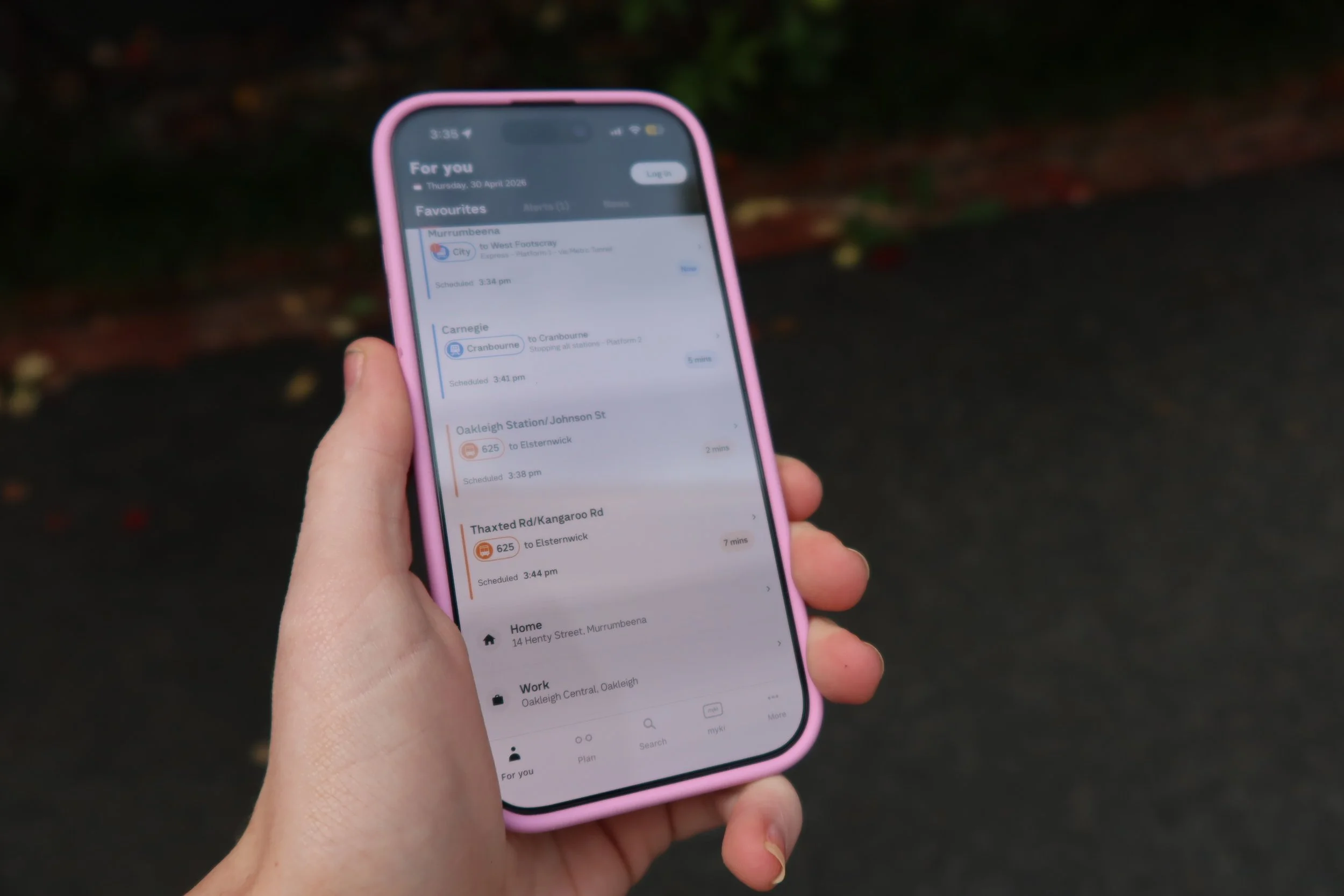
A commuter checks the PTV app. For many Melbournians, real-time tracking has become unreliable. April 2026. Photo: Madeleine Faure
For Tange, 23, the maths is unforgiving. On a full-fare Myki, she pays the daily cap every weekday, costing her approximately $55 a week and well over $2,700 a year just to get from her flat in Kew to her workspace in the city. When the 2026 increase landed, what shocked her was not the figure. It was the timing
“I'm paying more right now, today, for a service that is unreliable now”, she says. “The investments feel like it's for future commuters, not for its current ones”.
The unreliability Tange describes is not a matter of bad luck. She has been late to work because of PTV delays on multiple occasions this year. She has stopped making plans that depend on the tram running on time. The buffer she builds into her daily routine is not caution, it's a necessity.
“You stop feeling like a person who has any control over their own schedule”, she says.
Tange is not an outlier. An online survey of Melbourne commuters conducted for The Burne in March 2026 found that unreliable journeys are a near-universal experience across the network. Nearly half of responders said their commute fails to go to plan regularly: 26 per cent reported occasional disruptions, while 22 per cent said it happens several times a week.
The financial pressure is registering too, even among those who have not yet changed their behaviour. When asked whether rising public transport costs had affected how often they travel, 33 per cent said not yet, but are increasingly conscious of what it costs them. For many, cutting back on PTV is not a realistic option. The tram, train, and buses, however unreliable, remain the only way to get where they need to go.
Flourish Timeline: The Promise vs The Reality: PTV
The promise gap looks different in the outer suburbs. Anre Van Hooft, 30, leaves his home in Brighton early each morning to Flinders Street, then the Frankston line out to his job in Dandenong. On a good day, the journey takes him just over 1 hour. But, with the regular replacement bus stretch between Mordialloc and Frankston, it's closer to two. Three hours a day, minimum, just in transit.
“Replacement Buses and train delays have made the journey feel horrendous and slow”, he says. “I’m not sure how much longer I can do this for”.
Van Hooft owns a car, but originally chose public transport to save money on petrol. After the 2026 fare rise, and after three years of delays and replacement buses on his line, that calculation has begun to feel hollow.
“The system is asking outer suburban commuters to subsidise infrastructure they won't see the benefit from for years, maybe even decades to come”, he says.
A commuter waits on the platform at Murrumeena Station. April 2026. Photo: Madeleine Faure
Commuters’ frustrations aren’t a matter of perception; they reflect a system-wide reality. Melbourne’s rail network is being asked to serve a rapidly growing population while relying on infrastructure that, in some areas, is more than a century old. Industry data show that disruptions fall into two categories: planned and unplanned. Planned disruptions are largely driven by the state’s ongoing Big Build program, which has required frequent shutdowns to facilitate major upgrades such as level-crossing removals, station redevelopments, and the Metro Tunnel. Over the past year alone, there have been nearly 600 planned disruptions, averaging about 50 per month.
Unplanned disruptions are even more frequent and far less predictable. Trespassing, infrastructure failures, and incidents such as copper theft can halt services without warning. In 2023–24, more than 6,400 trespassers entered the rail corridor, equating to almost 20 incidents every day.
For Clare Abbott, Chief of Staff and Executive Director of Corporate Affairs, the frustration felt by commuters is understandable, but the reality behind delays is more complex than it appears.
“Disruptions are made up of two components: planned and unplanned,” she explains. Planned works, while inconvenient, are necessary to deliver long-term improvements. “It’s like servicing your car. There are things on the rail network that need to be checked, replaced and maintained to ensure it runs smoothly”.
Yet much of what causes delays sits outside immediate operational control. Trespassing remains one of the biggest challenges, with the majority of incidents intentional
“Over 90 per cent of these are people intentionally going onto our network,” Abbott says, noting the serious safety implications.
While demand continues to grow, particularly on weekends, Abbott maintains that capacity is being carefully managed. “We are running as many services as possible… There are limits to how many trains can operate safely on a line”.
Where she sees room for immediate improvement is in communication. “Passengers want real-time information so they can make decisions,” she says. When that information is delayed or inaccurate, frustration intensifies, even when the disruption itself is unavoidable.
For commuters like Tange and Van Hooft, the explanations offer context, but not relief. The distinction between planned and unplanned delays does little to change the outcome: missed meetings, longer days, and a constant sense of uncertainty.
The system asks for patience, for understanding, for time. But time is exactly what commuters feel they are losing. Each delay, each replacement bus, each inaccurate update compounds into something larger than inconvenience. It becomes a daily negotiation between cost and reliability, between expectation and reality, where the burden consistently falls on the passenger.
Melbourne’s transport network is not standing still. It is being rebuilt, expanded, and reimagined. But for those using it today, the future promise is competing with present frustration.
The gap between what commuters pay and what they experience is not just financial; it is psychological. Trust in the system is shaped not by long-term plans, but by daily performance.
Until reliability improves, or at least communication does, that gap will remain. And for hundreds of thousands of Melbournians, the question is no longer whether the system will get better, but how long they are expected to wait for it to do so.
A commuter waits on the platform at Murrumeena Station. April 2026. Photo: Madeleine Faure